Abstract geometric illustration representing the TeamPoint quotation process, using blue, navy, purple and yellow brand colours.

From Quote to Invoice: How TeamPoint Keeps the Commercial Process Connected.

08.09.26inPlatform Capabilities
Written by
Portrait of a TeamPoint blog author for the Knowledge Centre.
Rosie Cottell
HOME/KNOWLEDGE CENTRE/from-quote-to-invoice-how-teampoint-connects-the-whole-process
Platform Capabilities08.09.26

From Quote to Invoice: How TeamPoint Keeps the Commercial Process Connected.

This guide explains how TeamPoint manages the full quoting process, from the first enquiry or site survey through to pricing, approval, customer acceptance, job, Project or Service Contract creation, invoicing and reporting.

We’ll look at how TeamPoint handles different types of quotes, customer-specific pricing, margin, quote options, approvals, deposits, variations, Service Contracts and the wider quote-to-invoice workflow.

By the time a quotation reaches a customer, someone may already have dealt with an enquiry, visited a site, taken photographs, worked out labour and material requirements, checked supplier prices, considered margin and decided what terms should apply. Once the customer says yes, that information needs to move into the work itself: scheduled jobs, Projects, recurring services, purchasing, variations and invoices.

TeamPoint is designed to keep those stages together. Quoting sits within the same job and business management platform used to manage the work after it has been agreed, so information captured and decisions made at quote stage can continue into operations, finance and reporting.

How TeamPoint handles different types of quoted work.

TeamPoint handles quoted work differently depending on what kind of work it is. A £300 reactive repair does not need the same structure as a £100,000 refurbishment Project, and a quarterly service agreement needs something different again.

TeamPoint supports quotations across three main categories of work:

The likely route may already be identified from the original enquiry or survey, and that is then reflected in the quotation. A straightforward repair or one-off visit can sit within a Work Order. Larger or more complex work can be quoted as a Project, with a broader structure for multiple jobs, purchasing, variations, project costs, invoicing and profitability. Recurring work can be quoted as a Service Contract, with the ongoing service pattern and invoicing managed accordingly.

This means TeamPoint does not treat every accepted quote as the same type of job. The quotation sits within the operational structure that best fits the work, and if that changes as more information becomes available, the route can be changed later where appropriate.

How TeamPoint carries survey information into the quote

In TeamPoint, the quotation can start taking shape before any pricing is entered. Straight from the initial enquiry, a prospect may already sit with an account manager, and where a site survey is needed, that survey becomes part of the commercial record rather than a separate exercise.

The survey can be sent to site through the mobile app and completed there, with photographs, site details and the surveyor’s findings captured as part of the record. By the time the office is ready to prepare the quotation, the background is already available: survey information, relevant emails, internal notes and other communication can all sit alongside the customer or prospect record.

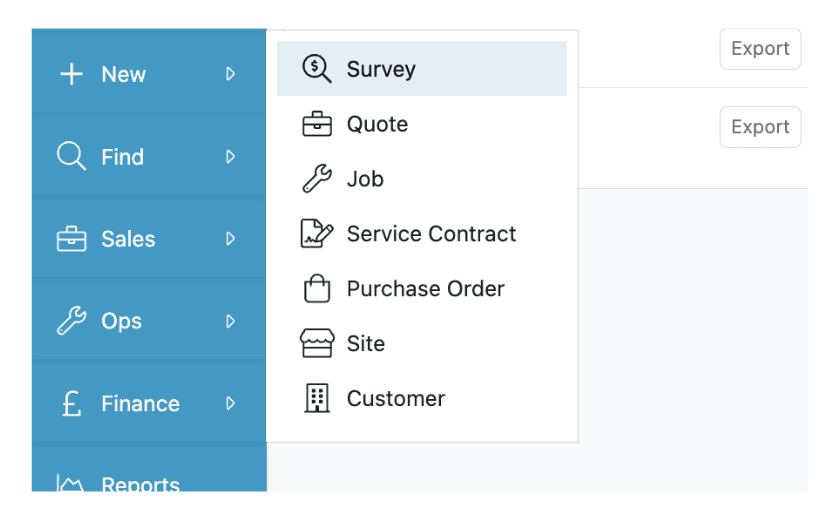
TeamPoint menu showing options to create a Survey, Quote, Job, Service Contract, Purchase Order, Site or Customer.
Survey Workflow

Products, prices and descriptions can then be added around the information actually gathered on site, rather than somebody having to piece the job together from scattered notes, attachments and inboxes.

For the person pricing the work, that gives a clearer picture of what has been found, what has already been discussed and what the customer is expecting.

The commercial record builds as the quote develops.

As a quotation develops in TeamPoint, the commercial detail around it builds in the same record. Alongside the scope, customer and site information, TeamPoint can record who is selling and managing the opportunity, which division and type of work it belongs to, where the enquiry came from and how urgent it is.

Dates such as the quote due date, validity period and expected close date help place it within the sales pipeline, while PO information, files, emails, checklists and internal notes keep the supporting detail alongside it.

Tags add another useful layer. They can be attached to quotations to identify or group work in ways that are meaningful to the individual business, and quotes can then be searched and filtered using those tags alongside criteria such as salesperson, division, job type, source and stage.

Quotes can remain in draft while they are being worked on. Existing quotations can also be edited or copied into a new quote where required, while the audit log records who changed a quotation, when it was changed and what was altered.

Emails can be sent from the quotation itself and the communication history remains associated with it. Files can be stored there too, giving anyone who becomes involved later a clearer record of the discussions and information behind the price.

TeamPoint gives you flexible quoting, from simple totals to detailed costings.

TeamPoint supports everything from a single-value quote to a fully costed quotation built from labour, materials, products and customer-specific rates. Some customers build quotes from individual labour and material lines; others work with a single overall value. Both approaches can sit within the same system.

Where a detailed quote is needed, the quoted lines come from the customer’s own TeamPoint product library. That library can contain the products, services and labour items the business needs, with records updated as prices, suppliers or commercial arrangements change.

Each product can carry much more than a selling price. TeamPoint can hold the cost price, sale price, preferred supplier, unit, category, service time, inclusive hours, VAT code, price-last-checked information, supplier pricing and purchasing history. When that item is added to a quotation, the quote line can then carry the quantity, cost, selling price, discount, total and tax.

Customer-specific pricing can work in much the same way. TeamPoint can apply different rates or discounts for particular customers, so the same labour or product item can be priced differently depending on who is being quoted without relying on the person preparing the quote to remember the rate each time.

For businesses that buy and resell materials, preferred supplier information, supplier prices and purchasing history can also provide useful context when the work is being costed.

And where none of that detail is needed, TeamPoint does not require it. A quotation can be based on a single overall value instead.

VAT can be handled at more than one level. A customer can have its own VAT treatment — for example, VAT-exempt status — while individual products and services can also carry their own VAT code. Customer and product VAT treatment can then continue through from quotation to invoice.

TeamPoint quotation showing product and labour line items with quantity, cost price, selling price, discount, VAT and totals.

Quote templates that make quoting quicker.

TeamPoint quotation templates are designed to give businesses consistency without forcing every customer, division or type of work through the same format.

A company may only need a small number of quote templates, or it may need several for different divisions, job types, customers or recurring kinds of work. TeamPoint can support as many as required, with templates including pre-populated line items, pricing, standard text and terms and conditions.

The design and branding can also be tailored to match the rest of the business. Logos, colours, layout and presentation can be configured so the quotation feels like part of the same company identity as the website, emails and other customer-facing material rather than looking like a generic document produced by software.

Terms can cover areas such as working hours, availability, quotation validity, cancellation, VAT and payment arrangements. The person preparing the quote selects the appropriate PDF template, can amend the quotation where needed and can preview the finished document before it is sent. The templates themselves are configured with the customer during setup. For a smaller company, that might mean two or three well-designed templates covering most of its work. A larger contractor may need different templates across divisions, customers or contract types.

Example TeamPoint quotation showing customer quote options, optional extras, online acceptance fields and a detailed quotation preview with pricing and totals.With TeamPoint you will know the expected profit margin before the quote goes to the customer.

As a quotation is being built in TeamPoint, the selling price is not shown in isolation. The person preparing it can also see the total cost behind the work, expected gross profit and margin percentage.

A £50,000 job may look attractive in terms of turnover, but if labour, materials, subcontractor costs or supplier prices have pushed the margin down, that is visible before the quotation leaves the business.

Discounts can also be applied at line-item level, so their effect on the commercial position can be considered as part of the quote.

For the person reviewing it, the likely profitability of the work is visible while the pricing decision is still being made rather than only becoming clear once the job has been delivered.

You can offer different options in a single quote.

Some jobs come with choices. A customer may be deciding between two different scopes, comparing specifications or considering whether to add extra work while the main job is being done.

TeamPoint can keep those choices within one quotation. Line items can be grouped into main options, where the customer chooses between alternatives, and optional extras, which can be added to whichever option they select.

For example- a roofing contractor preparing a quote for a customer who definitely needs the main roof replaced, may also want the flat roof done at the same time and has asked for a separate price for the porch roof. The quotation could show:

  • Option 1: main roof only

  • Option 2: main roof plus flat roof

  • Optional extra: porch roof

The customer sees those choices together and can select the combination they want. Before a decision is made, TeamPoint can also show the maximum potential quote value based on the highest-value main option together with all optional extras. Once the customer accepts, the quotation value updates to reflect what has actually been chosen.

For a Project quotation, the accepted options and extras can then feed directly into the value of the Project created from the quote.


You can set different quote limits for different employees.

Different people in your business may have different levels of commercial authority, and TeamPoint can reflect that in the quoting process.

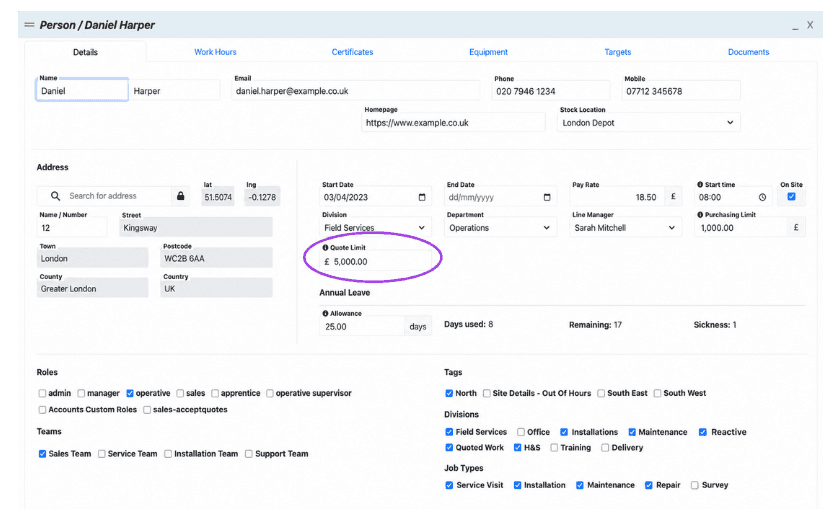
An individual quotation limit can be set for each employee. Someone dealing with routine work can prepare and send quotes within their normal level of responsibility, while a higher-value quotation can be held for approval by a manager or director.

If a quote goes above the limit set for that employee, TeamPoint keeps it as unauthorised and prevents it from being emailed to the customer until the appropriate approval has been given. Quotes waiting for approval can be surfaced on the dashboard, and the relevant approver can also be notified depending on how the business is configured.

Example TeamPoint employee record with completed personnel details, roles, divisions and a highlighted quote limit field showing how quotation authorisation limits can be set per person.

The limits themselves are permission-controlled. Permission to alter another employee’s quotation or purchasing limit would normally sit with people at managerial level rather than being available to everyone.

That gives employees freedom to deal with everyday quotations within the authority they have been given, while larger commercial commitments can follow the approval route the business requires.

TeamPoint gives you a quick and easy online acceptance option for your customers

TeamPoint quotations can be sent to customers as an online link, giving them the option to review the quote and accept it without printing, signing or sending anything back separately.

The acceptance process can capture the customer’s name, job title, purchase order number, an optional PO document and any additional notes they want to include. Once accepted, that information stays with the quotation.

If acceptance comes back another way, the quotation can also be marked as accepted by the office, so businesses are not dependent on customers using the online route.

Online quotation email with a Click to View & Approve button for customers to review and accept a quote.
Quote Approval

The record then provides something useful to refer back to if there is a later question about scope, price, extras, PO details or what was approved.

TeamPoint can also help manage quotations that remain open. Quotes can carry a validity period and move to Expired when that period ends. Staff can be reminded when an outstanding quote needs following up, automated reminders can be sent to the customer, quotations can be placed On Hold and a reason can be recorded if a customer declines.

Those rules can be configured around the way the individual business manages its quotations.

What happens after a quote is accepted in TeamPoint?

Every service business handles accepted work a little differently. Some want a finance check before a job is released, some need a deposit, some move work straight into scheduling and others have additional stages depending on the type or value of the work.

TeamPoint is configured with each customer so the process after acceptance follows the way that business wants to operate.

For a Work Order quote, the accepted quotation can become a job and move through whichever stages the workflow requires. For some businesses that might include a finance check before the job is released; for others it may move straight into scheduling. The relevant commercial and acceptance information moves with the job and the link back to the original quotation is retained.

For a Project quote, TeamPoint creates the Project record and carries the quotation information into it. If the customer has selected particular quote options or extras, those choices can become part of the Project value automatically.

A Service Contract quote follows its own route. Once accepted, the customer, site and relevant quotation information can move into the Service Contract, where the ongoing services, dates, invoicing arrangements, contacts and documents can then be managed.

How TeamPoint handles deposits before work starts.

For businesses that take a deposit before work begins, TeamPoint can make that part of the job process once the quotation has been accepted.

A deposit request can be created from the job either as a percentage of the total value or as a fixed amount. TeamPoint then creates the invoice and payment request, which can be sent to the customer. Businesses using Stripe, the online payment service, can also let the customer pay the deposit directly from that request.

If payment needs to be received before the job progresses, TeamPoint can hold the job at Waiting for payment until the deposit has been received. The job can then move through the next stage of the workflow configured for that business.

The deposit can therefore become part of what determines when the work is released rather than being recorded only as a finance note.

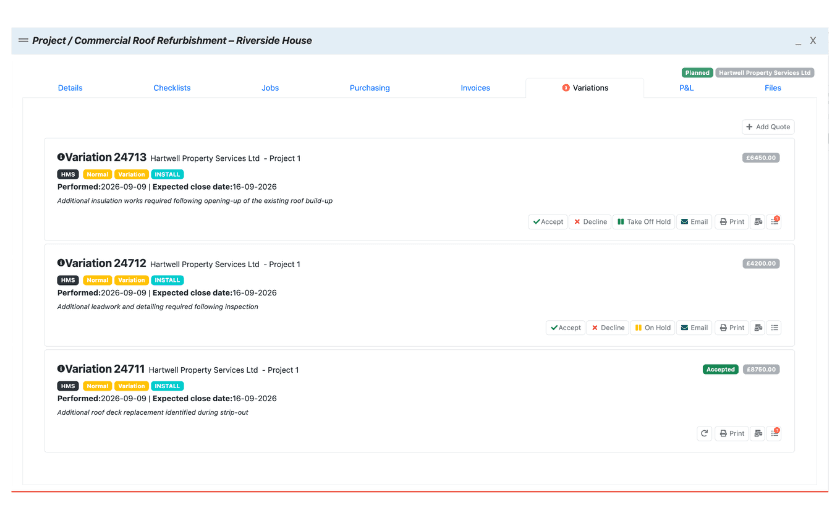
As work progresses, variation quotes can be raised against the Project for additional or changed work.

For larger Projects, the original quotation is not always the final commercial value. Scope can change, extra work may be identified, or the customer may decide to add something after the work has started.

In TeamPoint, additional work can be quoted as a variation against the existing Project. Once that variation is accepted, its value is added automatically to the overall Project value without disrupting work that has already been scheduled or completed.

TeamPoint Project showing three roofing variations with different values and statuses, including one accepted variation.

The Project can hold the wider commercial picture too, including jobs, purchasing, invoices, variations, checklists, project costs, P&L, overall value and gross margin. Purchasing can sit at Project level or against individual jobs and still feed into the wider financial view.

For businesses working on larger contracts, that gives a clearer view of how the financial position develops over time. TeamPoint can also track retentions, including those outstanding, in dispute, due soon or overdue.

A service contract quote can become the basis for ongoing scheduled work.

When a Service Contract quotation is accepted in TeamPoint, the relevant customer, site and commercial information can move into the live contract along with the services that have been agreed.

From there, the Service Contract can hold dates, PO information, invoicing arrangements, contacts, documents and the recurring service pattern behind the work.

That service pattern might mean four visits a year, specific months when work is due, or another recurring schedule. TeamPoint’s Service Dashboard can then show jobs and invoices that need to be created across those contracts.

The quotation process comes back into play later too. A renewal quote can be created from the Service Contract and additional work can be quoted against it as the customer’s requirements change.

For businesses built around planned maintenance or recurring service agreements, the original sale can therefore lead naturally into the ongoing programme of work and later renewal.

..and the information stays connected from the quote right through to the final invoice.

Once quoted work has been accepted and turned into a job, the original pricing and commercial information can carry through into invoicing. TeamPoint can create an invoice directly from the job using the quoted line items or value.

For example, if a maintenance job was quoted using a mixture of labour and materials, those values are still available when the invoice is raised. If something has changed along the way — perhaps extra work was authorised or additional materials were needed — the final invoice can reflect what was actually delivered rather than being tied rigidly to the original figure.

The invoice remains linked to the underlying job and site. TeamPoint also supports deposit invoices, credit notes, invoice disputes and invoice or credit exports, while VAT treatment set at customer or line-item level can continue from quote to invoice.

You can quickly see what is happening across all of your quotes.

TeamPoint gives you visibility across your quotations through dashboards and searchable quote lists. At a glance, managers can see how much work is sitting at different stages of the sales process and where something may need attention.

Dashboards can show, for example, quotations that are awaiting authorisation, have not yet been emailed, remain outstanding, have expired or have already been accepted. They can also show the value attached to those quotes.

That might mean spotting that a substantial amount of quoted work is still open, that several higher-value quotes are waiting for approval or that a group is approaching the end of its validity period.

TeamPoint quotes dashboard showing quote stages with counts and values, a monthly quotes bar chart, and a Quotes By Type table summarising draft, open, on hold, expired, accepted and declined quotations.

The quote list can add more context, including the salesperson responsible, expected close date, quote value, cost, expected gross profit, margin and type of work.

When a more specific view is needed, TeamPoint’s Find Quotes screen can filter by criteria including salesperson, source, stage, division, job type, tag, priority, postcode and a range of dates. A manager could, for example, look at outstanding Project quotes for one division, everything quoted by a particular salesperson or quotations generated from a particular source.

TeamPoint draws together the commercial data generated during the quotation process into useful reporting tools.

TeamPoint includes a wide range of reporting tools around quotations, sales, customers and commercial performance. Because quoting takes place within the same system used to manage the work and invoicing, managers can look beyond how many quotes were sent and start looking at what those quotations actually produced.

The Sales reporting area includes reports such as Quotes, Quotes by Customer, Sales by Product, Sales by Postcode, Sales by Source and Declined Quotes by Reason.

Monthly quotation reporting can also show quoted, accepted and declined activity over time, making it easier to see whether sales activity and the value of won work are changing from one period to another.

In practice, that can help answer much more useful management questions. Which customers are accepting the greatest value of work? Which lead sources are producing worthwhile business? Are some divisions quoting heavily but converting poorly? Are particular products or types of work performing better than others? Why are quotations being declined? And which salespeople are turning opportunities into orders and invoices?

The reporting is not limited to a fixed set of standard reports either. TeamPoint includes a substantial range of existing dashboards and reports, but where a business needs to analyse something more specific, our team can also create customised reports as long as the necessary data is being captured in TeamPoint.TeamPoint Quotes by Customer report showing accepted, rejected, outstanding, expired, total performed and not performed quotation values across multiple customers.Over time, the quotation process therefore builds up much more than a history of prices sent to customers. It creates commercial information that managers can use to understand where work is coming from, what is converting, where opportunities are being lost and where future sales effort is likely to be most worthwhile.

What are your priorities?

Quoting can be as straightforward or as detailed as your business needs it to be. You may want to create and send quotes faster, improve visibility of margin and approvals, manage variations more effectively, or understand what is being accepted, rejected and left outstanding.

TeamPoint can support those priorities as part of the wider way your business operates.

Read more about how TeamPoint works, hear directly from our customers in our testimonial videos, or get in touch to explore what TeamPoint could look like in your business.

You may also like

Close-up of loft insulation rolls beneath exposed timber framing and brickwork during a UK home retrofit.
Industry Knowledge
Written by
Portrait of a TeamPoint blog author for the Knowledge Centre.
Rosie Cottell

What software does a UK retrofit contractor need to manage projects and be audit ready?

A practical guide to the software UK retrofit contractors need to manage complex projects, connect specialist systems, reduce admin and keep project information clear, complete and ready for reporting or audit.

02.09.26
Read More
Commercial Cleaning Management Software UK: What Growing Cleaning Businesses Need in 2026
Industry Knowledge
Written by
Portrait of a TeamPoint blog author for the Knowledge Centre.
Rosie Cottell

Commercial Cleaning Management Software UK: What Growing Cleaning Businesses Need in 2026

If you manage a growing commercial cleaning business, this guide will help you work out which software you really need, where specialist systems fit and how to keep the wider operation under control as you take on larger contracts.

24.08.26
Read More
Electronic access fobs and keys used for facilities management
Industry Knowledge
Written by
Portrait of a TeamPoint blog author for the Knowledge Centre.
Rosie Cottell

How FM Businesses Balance PPM & Reactive Maintenance & Make Better Use of Engineer Time

This article explores how facilities management businesses can balance planned and reactive maintenance more effectively by using operational data, connected workflows and better scheduling. It looks at how job management software can help teams prioritise urgent work, support engineers in the field, identify recurring asset issues, improve first-time fix rates and use reporting to make better use of maintenance resources.

19.09.2026
Read More
Engineer using a mobile device while inspecting a commercial grease trap
Industry Knowledge
Written by
Portrait of a TeamPoint blog author for the Knowledge Centre.
Rosie Cottell

Grease Trap Servicing: What to Look for in a Field Service Management Platform

Grease trap servicing businesses often manage far more than routine maintenance, from multi-site contracts and reactive drainage work to reporting, customer records and complex field operations. This article explores what operations and general managers should expect from a modern FSM platform, and why TeamPoint is particularly well suited to the demands of the grease-management sector.

13.08.2026
Read More