There is now a wide range of software available to commercial cleaning businesses, much of it highly specialised. You may already use one system for HR, payroll or attendance, another for audits and quality inspections, with separate technology for suppliers, customer requirements or smart sensors. The difficulty comes when information starts to spread between them. Customer or contract details are entered more than once, changes made in one place do not reach another, and managers find themselves checking several systems to understand what is happening. Administration increases, handovers become less reliable and there are more opportunities for information to be missed or entered incorrectly.
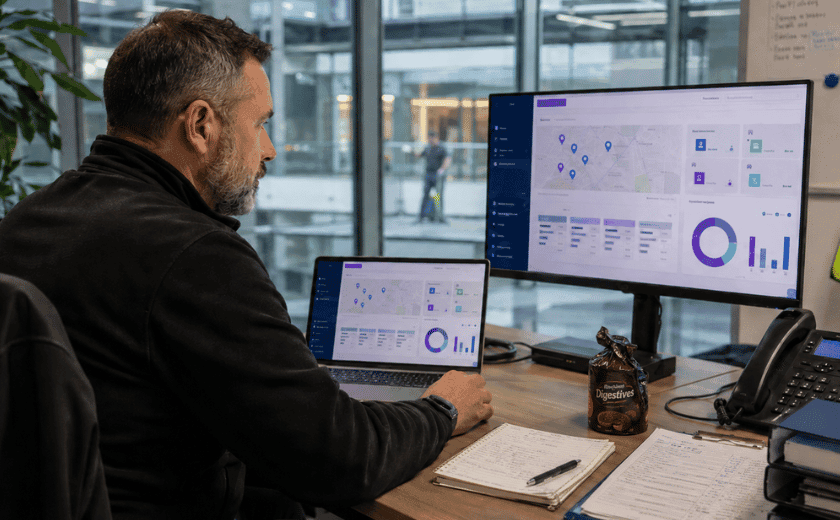
This is where broader job management software can become valuable for commercial cleaning businesses. Its role is to provide the operational structure around the customer and contract, bringing together sites, quotations, scheduling, recurring work, variations and additional works, purchasing, service records, evidence, invoicing and management reporting. The aim is not to replace specialist software that is already doing an important job. It is to make sure the wider business does not become fragmented around it.
What types of software do commercial cleaning businesses use?
If you are researching software for a growing commercial cleaning business, the amount of choice can be baffling. Many platforms overlap heavily, making it difficult to work out what you genuinely need and what would duplicate functionality you already have.
CleanManager combines cleaning schedules, time tracking, audits, wage and invoice calculations, quotations and a client portal. Connecteam focuses more heavily on workforce management, with scheduling, clocking in and out, timesheets, communication, training and digital forms. Timegate+ goes deeper again into attendance, staffing, labour control, SLA monitoring and contract compliance. KleanFlo covers a wider customer journey, including prospects, quotations, mobilisation, schedules, attendance, audits and customer portals. Xota focuses strongly on recurring rotas, cleaner clock-in, absence, payroll calculations and proof of work, while Trade2Base combines contract scheduling, staff rotas, quality reports, COSHH records, photographic evidence and client reporting.
There is considerable crossover between them. Scheduling, mobile working, forms, photographs, customer information, reporting and proof of service appear repeatedly. That is why more software is not necessarily better. The aim should be to use as few systems as possible, keeping specialist software where it adds genuine depth, particularly around areas such as clocking in and out, attendance, absence, payroll-ready hours, employee self-service and workforce administration.
:quality(90))