
How to Grow Your Service Business Without Losing Control.

How to Grow Your Service Business Without Losing Control.

16.07.2026inRunning a Service Business
Written by
Rosie Cottell
Rosie Cottell
HOME/KNOWLEDGE CENTRE/how-to-grow-your-service-business-without-losing-control-what-growing-service-businesses-do-differently
Running a Service Business16.07.2026

How to Grow Your Service Business Without Losing Control.

Growing a successful service business isn't just about winning more work. It's about making sure your business continues to run efficiently as it becomes larger and more complex. This article explores the habits shared by successful service businesses, from building dependable processes and keeping information connected to managing projects, compliance and business performance. Discover how the right operational approach helps growing businesses stay organised, improve profitability and continue growing without losing control.

Losing control of what's going on in your business doesn't happen all at once; it creeps up on you. As the business grows, there comes a point where there's just too much for any one person to keep on top of. Engineers phone the office for information they should already have. Customer enquiries take longer to answer. Managers spend more time chasing updates than planning ahead. Paperwork begins to build up and profitability becomes harder to understand. None of these problems seems significant on its own, but together they slow the business down and create unnecessary pressure across the whole organisation.

If you're reading this article, you've probably already reached an important conclusion: the way your business operates needs to step up a level if it's going to support the next stage of growth.

Maybe you’re looking to move away from  spreadsheets and disconnected processes. Perhaps you're already using job management software, but it is not agile. You may be offering new  services, projects have probably become more complex and customer expectations have changed. For whatever reason, the software no longer reflects the way your business operates and this is leading to extra administration, duplicate data entry and using separate systems to fill the gaps. Growing businesses often outgrow the software they originally chose- not because the software isn’t good,  but because the business now operates differently.

Choosing your next platform isn't just about replacing software. It's about choosing an approach that will support your business as it grows over the coming years.

The businesses that continue to grow successfully don't usually do so by working longer hours. They continually look for better ways to operate, removing unnecessary effort, removing unnecessary administration and making the business easier to manage as they grow.

We've worked with customers across Roofing, Solar & Renewable Energy, Drainage, Facilities Management, Building Maintenance, Commercial Cleaning, Utilities and Retrofit. Although every business is different, we've found that the most successful share a common mindset. They never stop asking how they can improve. They refine the way work flows through the business, make information easier to access and remove unnecessary administration wherever they can.

The principles in this article are based on what we've learned from working with those businesses.
Make Your Business Less Dependent on Individuals.

In the early stages of a service business, experience and personal knowledge keep everything moving.

It's perfectly normal for one person to remember which quotation needs chasing, another to know the history behind a long-standing customer, and someone else to know exactly where a drawing or certificate is stored. Then a few key staff members hold the bigger picture in their heads.

As the business grows, information becomes one of its most valuable assets—but also one of its biggest management challenges.

Growing businesses don't lose the personal service that helped make them successful. If anything, they value it even more. The difference is that they free experienced people to focus on supporting customers, solving problems and delivering great work, rather than spending their day remembering routine administration or answering questions that others should be able to resolve themselves.

Successful businesses create a clear way for work to move through the business. Enquiries, quotations, jobs, projects and invoices all follow a logical journey that everyone understands. New employees become productive more quickly, managers spend less time checking routine work and customers enjoy a more consistent experience.

Make Information easy to Find.

One of the first things that becomes harder as a service business grows is finding information.

Here are some examples: a customer telephones asking about work completed two years ago. An engineer needs to know what was done during the last visit. A project manager wants to check whether additional work was approved. An office administrator needs to find a RAMS document before work can begin.

The information exists—but it's often spread across emails, shared drives, filing cabinets, different software systems or the memories of experienced employees. Finding the answer can take far longer than it should.

Growing businesses need information to be organised, connected and easy to access, so every member of the team can quickly find what they need and keep work moving.

At TeamPoint, everything relating to a job is stored with the job itself. Quotations, customer communications, internal notes, contacts, worksheets, site photographs, previous work completed at the site, RAMS, compliance documents, related files, invoices and a complete history of who carried out the work are all connected in one place.

That means when someone opens a job, they aren't just looking at today's appointment. They have access to the complete history of the work, giving them the information they need within a click or two.

Feature Image
Information a click away

Keep your Office and Site Teams Connected.

In a well-run service business, the office and site teams should never feel like separate parts of the organisation. They should be working from the same information, making confident decisions and keeping work moving without unnecessary delays.

As a business grows, keeping everyone connected becomes more challenging. Customer requirements change, engineers uncover unexpected issues, additional work is approved, materials are delayed and appointments are rearranged throughout the day. None of these things are unusual. The challenge is making sure the right information reaches the right people at the right time.

The businesses that continue to grow successfully don't rely on phone calls, emails or paper job sheets to keep everyone informed. Engineers update jobs as they work, while office teams can immediately see progress, answer customer queries with confidence and respond quickly when plans change. In the same way, engineers arrive on site with the latest customer instructions, schedules and job information already at their fingertips.

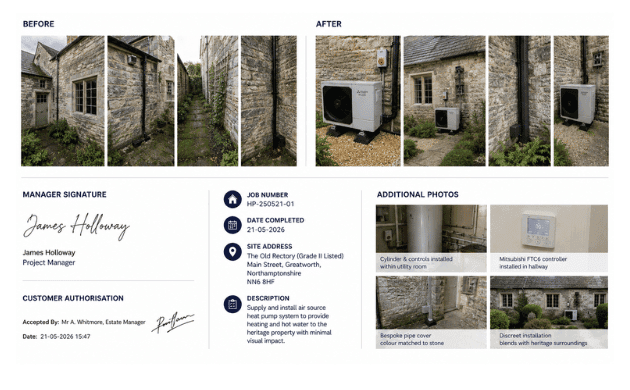
With TeamPoint's Mobile Working, engineers can complete digital worksheets, risk assessments and other required forms directly from site. Before-and-after photographs, surveys, drawings, supporting documents, time records, vehicle checks, equipment inspections and barcode scans are all linked to the job as the work is carried out. The office receives that information immediately, without waiting for paperwork to be returned.

Managers have a live overview of every job as it progresses, completed worksheets can be reviewed and sent to customers without delay, and compliance records are created as part of the normal workflow rather than as a separate administrative task.

The result is a better-informed office, better-prepared engineers, a more professional experience for your customers and a business that remains organised and in control as it continues to grow.

Feature Image
Site to Office communication

Manage every Job, Project and Contract with Confidence.

As a business matures, it often begins taking on different types of work. A company that once specialised in reactive jobs may progress to larger installations, planned maintenance programmes, multi-site contracts or long-term service agreements. As its reputation grows, existing customers place greater trust in the business, leading to larger projects, framework agreements and opportunities to secure public sector contracts that demand higher levels of organisation, compliance and reporting.

Growth also brings greater operational complexity. Projects involve multiple phases, specialist subcontractors, purchasing, customer approvals, design changes, variations and constantly changing timescales. Planned maintenance contracts need to be delivered consistently over months or even years, while keeping every visit, document and customer interaction connected.

Winning larger contracts is only part of the challenge. Delivering them efficiently, profitably and without losing control is what drives long-term success.

Trying to manage this type of work using spreadsheets, diaries or disconnected software quickly becomes difficult. Managers need to understand not only what has already been completed, but what happens next. They need a clear view of project progress, outstanding actions, costs, subcontractors, variations and profitability without piecing information together from several different places.

The businesses that continue to grow successfully understand that every job, project and contract should form part of one connected operation. Whether the work lasts a single day or several years, everything should remain linked from the original quotation through to scheduling, site visits, purchasing, compliance, invoicing and final completion.

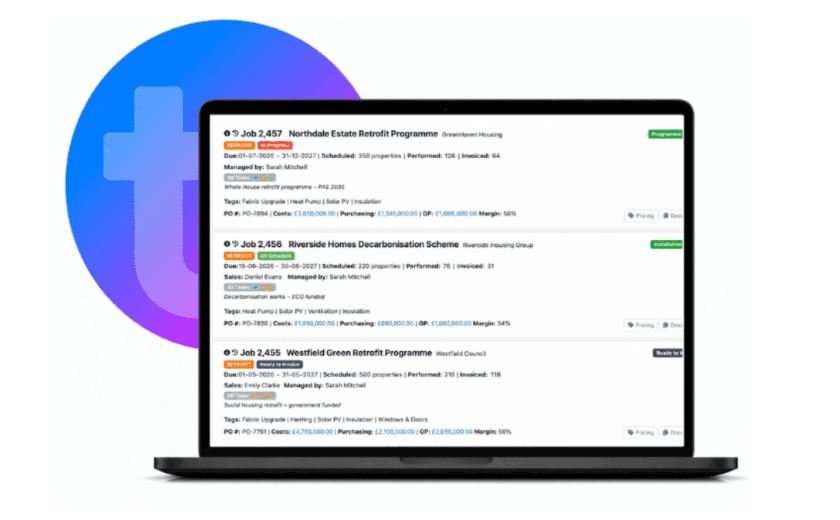
With TeamPoint, every stage of a project or service contract remains connected. Tasks, site visits, customer communications, drawings, photographs, purchasing, variations, worksheets, invoices and customer history all sit together, giving managers a complete picture of the work as it progresses.

That visibility makes it easier to allocate resources, monitor costs, manage subcontractors, keep customers informed and make confident decisions throughout the life of every project.

As your business grows, it gives you the confidence to take on larger, more complex work without losing sight of the details that matter.

Make Compliance part of Every Job.

Meeting compliance demands has become an increasingly important part of running a successful service business. Customers, insurers, industry bodies and public sector organisations all expect higher standards, better documentation and greater accountability than they did just a few years ago.

Larger customers expect higher standards. Public sector contracts often require detailed audit trails and supporting documentation. Industry regulations evolve, and customers increasingly expect evidence that work has been completed safely, professionally and in accordance with agreed standards.

Businesses that fail to keep pace can quickly find themselves spending increasing amounts of time chasing paperwork, recreating information from memory and checking whether every document has been completed before work can be signed off. Valuable time is lost, avoidable mistakes creep in and opportunities to win larger contracts can be affected.

The businesses that continue to grow successfully take a different approach. Compliance becomes part of the way work is delivered rather than something completed afterwards. Engineers capture photographs, complete digital worksheets and record the information needed while they are still on site, creating a complete record of the work as it progresses.

Capturing information once also removes a significant amount of unnecessary administration. Survey information, site records and job updates can be reused throughout the project to produce professional customer documentation and generate forms required by external organisations such as MCS, reducing duplicate data entry and improving consistency.

Successful businesses also recognise that compliance is about more than paperwork. Before work moves to its next stage, they need confidence that permissions have been granted, required inspections completed and supporting evidence is already in place. Building these checks into everyday operations helps prevent delays, protects quality and gives managers a clear overview of every project.

For growing service businesses, good compliance isn't about creating more administration. It's about building trust, protecting your reputation and giving customers confidence that your business can successfully deliver larger, more demanding projects without losing control.

Understand how Your business is Really performing.

There comes a point when you can no longer keep everything in your head.

As a business grows, instinct becomes less reliable. To make good decisions, you need accurate information. Which jobs generate the strongest profit? Are quotations turning into the right type of work? Which projects are beginning to drift? How productive are your teams? Where are the opportunities to improve?

The businesses that continue to grow successfully make decisions based on reliable information rather than assumptions. They understand where new enquiries are coming from, which customers generate the greatest long-term value, how profitable individual jobs and projects are, whether service contracts are performing as expected and where operational improvements will have the greatest impact.

That level of visibility helps managers spot trends before they become problems. It allows them to allocate resources more effectively, improve performance, protect profitability and plan for growth with greater confidence.

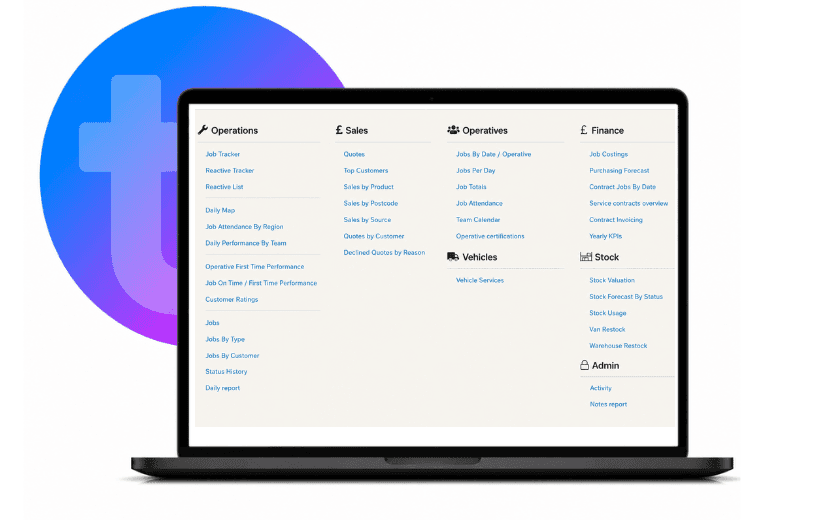
TeamPoint brings together operational, sales and financial reporting in one place, giving you a live picture of how your business is performing. From quotation performance and customer trends to job costing, project profitability, service contracts, purchasing forecasts and yearly KPIs, the information is always available when you need it. You can even see the profit margin on individual jobs once they have been invoiced, helping you understand not just how much work you're winning, but how much value that work is creating.

The businesses that grow successfully rarely do so by chance. They understand their business, learn from the information available to them and use those insights to make better decisions. That's how they continue to improve, protect profitability and grow without losing control.

Feature Image
Business metrics