What is Job Management Software? The Complete Guide for UK Field Service Businesses

What is Job Management Software? The Complete Guide for UK Field Service Businesses

10.07.2026inJob Management Software
Written by
Rosie
Rosie
HOME/KNOWLEDGE CENTRE/what-is-field-service-management-software
Job Management Software10.07.2026

What is Job Management Software? The Complete Guide for UK Field Service Businesses

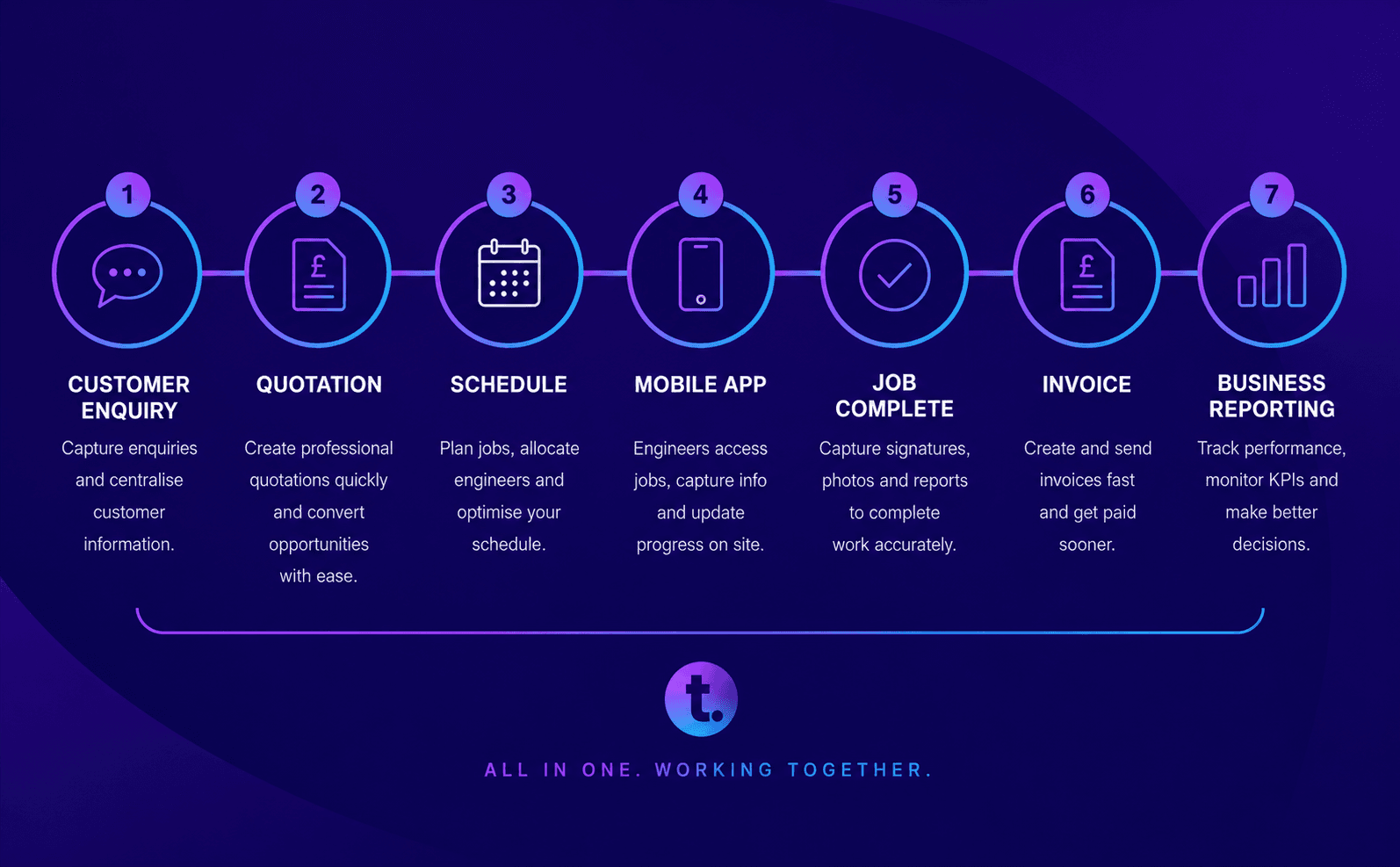
What is Job Management Software in Simple Terms? Job management software is a business platform that helps organisations plan work, manage customers, schedule engineers, complete jobs, generate invoices and monitor business performance. It connects every stage of the life-cycle of a job in one place, replacing spreadsheets, dislocated messaging and standalone systems.

Why Businesses invest in Job Management Software.

Most businesses don't begin their search for job management software because they're unhappy with the way they currently work. More often, they just reach a point where the tools they've relied on for years are no longer keeping pace with the demands of a growing business. They want to modernise, streamline and just do things as well as they possibly can.

Generally the systems and processes that have helped a business grow are the very reason it has been successful. They have evolved over time and are often ingenious. A spreadsheet is added here, another software package is introduced there, paper records remain important for some tasks and customer information becomes spread across several different systems. The business continues to operate successfully, but as they grow, maintaining those processes becomes increasingly time-consuming.

At the same time, customer expectations continue to rise and compliance requirements become more demanding. Businesses are expected to provide faster responses, maintain comprehensive records, capture site evidence and produce complete audit trails, all while continuing to deliver excellent customer service.

Many successful organisations reach a point where they begin looking for job management software, not because their existing processes are wrong, but because they need a more connected and streamlined way of working that will support this next stage of their growth.

Job management software addresses this by bringing every stage of the customer journey into one connected platform. Rather than maintaining separate systems for quotations, scheduling, mobile working, customer records and invoicing, businesses work from a single source.

The result is greater visibility, fewer manual processes, better decision-making throughout the organisation and time to spend on more valuable tasks.

Digital transformation is accelerating across the UK service sector as organisations invest in cloud technology, mobile working and automation to improve productivity and customer service. Job management software has become one of the key technologies enabling that transition.


Job Management Software, Field Service Management Software and Other Common Terms.

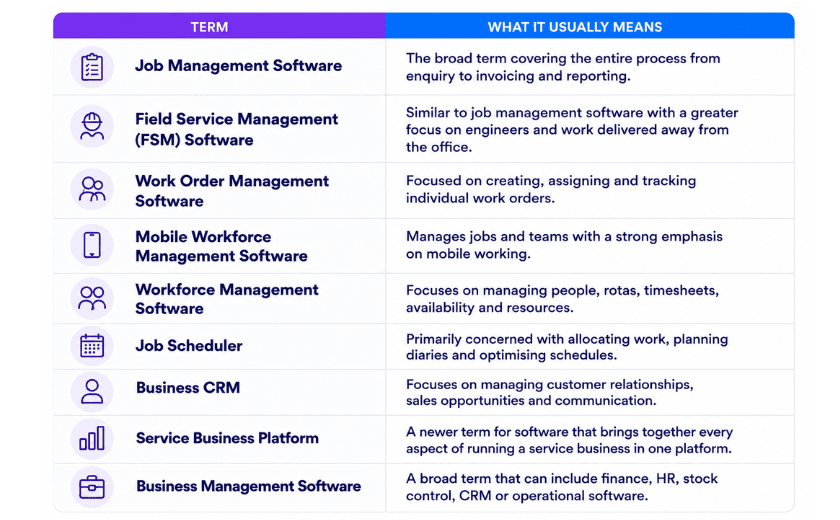
If you've started researching software for your business, you've probably noticed there are lots of different names for what often appears to be the same type of product.

One provider might describe it as Job Management Software, another- Field Service Management (FSM) Software, others use terms such as Contractor Management Software, Work Order Management Software or Mobile Workforce Management Software.

Although there are subtle differences, many of these terms overlap. The software is designed to solve the same fundamental challenge: helping businesses organise work, people and information more efficiently.

Job Management Software, Field Service Management Software and Other Common Terms.

Where Does TeamPoint Fit?

TeamPoint is best described as Job Management Software or Field Service Management Software, because it brings together every stage of running a field service business within one connected platform.

Rather than specialising in just one area, TeamPoint combines:

That means you don't need separate systems for scheduling, customer records, mobile job sheets and invoicing. Everything is connected, giving your office and site teams access to the same up-to-date information throughout the life of a job.

Where Does TeamPoint Fit?

The Evolution of Job Management Software.

The way businesses manage work has changed dramatically over the last fifty years. What began with paper diaries, filing cabinets and telephone calls has evolved into intelligent, connected platforms that bring together people, processes and information in real time. Understanding that evolution helps explain not only what job management software does today, but where it's heading next.

The Early Days of Digital Job Management

The evolution of job management software reflects a much broader shift in the way businesses use technology. Over the last fifty years, software has moved from storing information to helping organisations connect people, streamline operations and make better decisions.

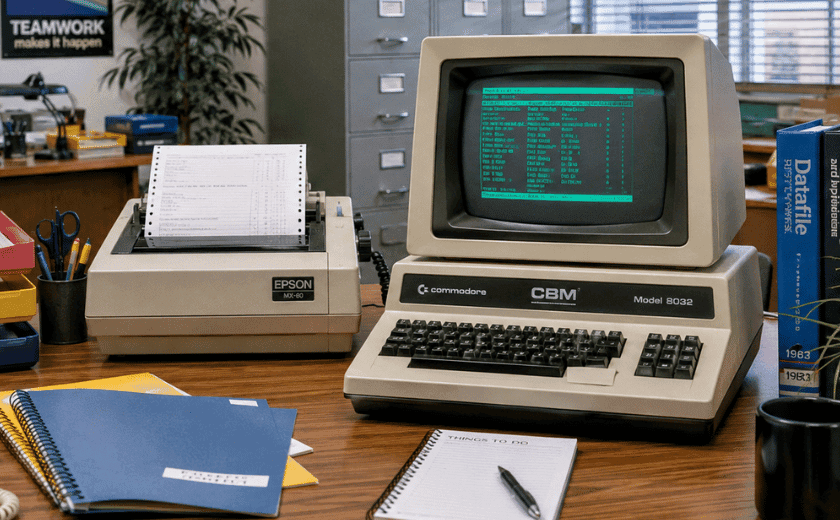
Not so long ago, managing a field service business relied on paper diaries, wall planners and filing cabinets. Jobs were allocated over the telephone, engineers carried paper job sheets and completed paperwork returned to the office at the end of the day. These systems often worked remarkably well because they were built around experienced people who understood their customers, their engineers and the areas they covered. However, as businesses grew, they became increasingly difficult to scale.

The introduction of personal computers during the 1980s and 1990s transformed office administration. Customer records, quotations, invoices and job histories became easier to organise and retrieve, replacing many manual processes. Yet operational information remained largely office-based. Engineers still worked from printed paperwork, and information often wasn't available until hours after a job had been completed.

The Early Days of Digital Job Management
Go Digital

The Cloud Revolution

The arrival of cloud computing and mobile technology transformed job management software in ways that previous advances couldn't.

For the first time, office teams and engineers could work from the same live information, wherever they were. Schedules could be updated in real time, engineers could receive new work while travelling, complete digital worksheets, capture photographs, collect customer signatures and record site information before leaving the job.

Meanwhile, office staff gained immediate visibility of progress. They no longer had to wait for paperwork to return at the end of the day before updating customers, ordering materials or preparing invoices. Information became available as the work happened, allowing faster communication, quicker invoicing and more responsive customer service.

This fundamentally changed the role of job management software. It was no longer simply a system for recording completed work; it became the operational hub of the business, connecting quotations, scheduling, mobile working, compliance, customer records, invoicing and reporting through a single, real-time platform.

The impact was profound. Businesses could make decisions based on what was happening now, rather than what had happened yesterday. That shift towards connected, real-time operations laid the foundations for the next generation of job management software.

The Cloud Revolution
Cloud based

The Intelligent Use of Operational Data

Today, the evolution of job management software is increasingly being shaped by the way businesses collect, connect and use operational data.

Every quotation, journey, completed job, customer interaction and engineer visit generates valuable operational information. Modern job management platforms can bring that information together to reveal patterns, improve planning, optimise resource allocation and provide a much clearer understanding of how a business is performing. Connected assets and IoT technology are also making predictive maintenance increasingly practical, allowing equipment to be monitored remotely and serviced before failures occur.

Artificial intelligence is also beginning to add another layer to these capabilities. Rather than replacing operational expertise, AI can analyse large volumes of information to support better scheduling, identify opportunities to improve efficiency and help businesses make faster, better-informed decisions. At TeamPoint, we see AI as a natural extension of good job management software—using connected data to support the people making decisions.

The Intelligent Use of Operational Data
Looking Ahead

The Future of Job Management Software.

The future of job management software will be shaped by better connected data and more intelligent decision-making.

Every quotation, customer enquiry, engineer visit, completed job and invoice generates valuable operational information. As software continues to evolve, businesses will increasingly be able to use that information to understand not just what is happening, but why it's happening.

Rather than just recording activity, modern platforms will help identify patterns, highlight bottlenecks, improve resource planning and reveal opportunities to work more efficiently. Artificial intelligence will play an important role in this by analysing large volumes of operational data and presenting useful insights that would be difficult to identify manually.

Operational efficiency and sustainability are also becoming more closely linked. Smarter scheduling reduces unnecessary travel, digital documentation replaces paper-based processes, and better planning helps reduce fuel consumption and avoid unnecessary waste. As these capabilities develop, businesses will gain a clearer understanding of both their operational performance and their environmental impact.

How different Industries use Job Management Software.

Businesses in many different sectors face the same challenge: coordinating people, information and work that takes place away from a central office. Whether it involves engineers, surveyors, inspectors, cleaning teams, installers or maintenance operatives, managing remote work efficiently becomes increasingly important as a business grows.

Job management software has evolved to support exactly that. While it has its roots in field service, it can be useful wherever work needs to be planned, scheduled, delivered and recorded outside a traditional office environment. As more organisations adopt digital ways of working, new and sometimes unexpected uses for this type of software continue to emerge.

Explore our Industry Guides.

TeamPoint Job management Software supports organisations across many sectors, including:

Explore our Industry Guides.
Industries
Support Hub

Frequently Asked Questions

Still have questions? Here are answers to some of the most common questions about job management software, field service management software and how modern platforms help businesses work more efficiently.

Help Desk

Still have questions?

Can't find the answer you're looking for? Our friendly UK-based support team is a message away and ready to help.

Talk To Us
The two terms are often used interchangeably. Both describe software that helps businesses manage work carried out away from a central office, including quotations, scheduling, mobile working, customer records, compliance, invoicing and reporting. Some providers use "Field Service Management (FSM)" while others prefer "Job Management Software", but the core purpose is the same: helping businesses organise and deliver work more efficiently.
Any organisation that manages people working away from a central office can benefit from job management software. It is commonly used by roofing contractors, electrical contractors, plumbing and heating companies, drainage specialists, facilities management providers, commercial cleaning businesses, renewable energy installers, building maintenance companies and many other organisations that need to schedule work, manage customers and coordinate mobile teams.
Many businesses begin looking for job management software when their existing ways of working become difficult to manage. Common signs include increasing paperwork, customer information spread across multiple systems, delayed invoicing, engineers regularly contacting the office for updates and growing compliance requirements. Investing before these issues become significant bottlenecks can help support future growth.
Most modern job management platforms can integrate with accounting software such as Xero and QuickBooks, as well as CRM systems, purchasing software and other business applications. Integrating these systems reduces duplicate data entry, improves accuracy and helps create a more connected workflow across the business.
Modern job management software is evolving beyond scheduling and administration. Cloud technology, connected operational data and artificial intelligence are helping businesses improve planning, identify trends, optimise resources and make better operational decisions. At the same time, growing sustainability requirements are encouraging businesses to use job management software to reduce unnecessary travel, improve efficiency and better understand their environmental impact.

You may also like

Is It Time to Change Your Job Management Software?
Job Management Software
Written by
Rosie Cottell
Rosie Cottell

Is It Time to Change Your Job Management Software?

Replacing your field service management software is a significant decision. If your current platform no longer reflects the way your business operates, this guide will help you understand when it's time to make a change, what to look for in a new system and how to plan a successful transition with minimal disruption.

20.07.2026
Read More
How to Grow Your Service Business Without Losing Control.
Running a Service Business
Written by
Rosie Cottell
Rosie Cottell

How to Grow Your Service Business Without Losing Control.

Growing a successful service business isn't just about winning more work. It's about making sure your business continues to run efficiently as it becomes larger and more complex. This article explores the habits shared by successful service businesses, from building dependable processes and keeping information connected to managing projects, compliance and business performance. Discover how the right operational approach helps growing businesses stay organised, improve profitability and continue growing without losing control.

16.07.2026
Read More
Has Your Service Business Outgrown the Way It Operates?
Running a Service Business
Written by
Rosie Cottell
Rosie Cottell

Has Your Service Business Outgrown the Way It Operates?

As service businesses grow, the systems and processes that once worked well can gradually become disconnected, making information harder to find, increasing administration and slowing growth. This article explores six signs your business may have outgrown the way it operates—and how connected job management software can help simplify operations and support continued growth.

14.07.2026
Read More