Managing Solar PV Installations in the UK in 2026: Software, Workflows and Compliance

Managing Solar PV Installations in the UK in 2026: Software, Workflows and Compliance

12.08.2026inIndustry Knowledge
Written by
Rosie Cottell
Rosie Cottell
HOME/KNOWLEDGE CENTRE/managing-solar-pv-installations-in-the-uk-in-2026-software-workflows-and-compliance
Industry Knowledge12.08.2026

Managing Solar PV Installations in the UK in 2026: Software, Workflows and Compliance

How UK solar contractors can reduce admin, keep projects and compliance under control, and manage increasingly complex installations. The article looks at how connected software and better workflows can improve visibility, reduce duplication and keep work moving.

In the UK today, solar PV is delivered by a broad mix of contractors, from specialist installers to roofing, electrical, retrofit, social-housing and building-services businesses.

For an operations manager, the challenge is coordinating the many moving parts involved in a solar installation. A typical project may involve surveyors assessing roofs, estimators preparing quotations, designers working in specialist solar software, administrators managing DNO applications, procurement teams ordering equipment,  scaffolders and electricians working to different programmes,  installers capturing evidence on site, compliance

teams checking documentation and finance staff waiting for the information needed to invoice. In some businesses, several of those responsibilities may sit with a relatively small office team coordinating a much larger network of operatives and subcontractors.

That is where the pressure starts to build. A missing approval can delay the installation. A survey detail held in the wrong place can lead to another phone call to site. A completed job can sit uninvoiced because finance is still waiting for paperwork. As volumes increase, the risk is that the job depends on individuals knowing what is happening rather than the business having one clear view.

Most of the best-known solar software focuses on technical design, proposals or compliance. Those functions are important, but they do not manage the whole operation.

The real challenge is keeping the process connected and making the right information visible to the people who need it, from the first survey through to installation, commissioning, billing and ongoing service.

What does the UK Solar market look like in 2026?

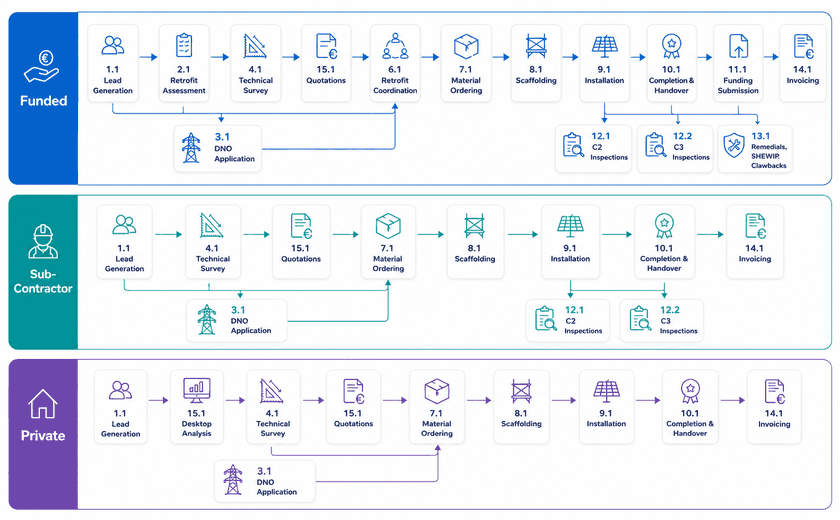
The UK solar market spans domestic installations, commercial and industrial projects, roofing and electrical work, retrofit programmes and large-scale delivery for social landlords and local authorities. Those routes can look very different operationally: a private domestic installation may move quickly from survey and design through DNO approval, installation and commissioning, while a funded retrofit programme may involve hundreds of properties, eligibility checks, resident liaison, staged approvals, evidence requirements and several subcontractors.

Government support has long influenced parts of the solar market, and contractors are familiar with funding schemes changing over time. In 2026, that landscape includes the Warm Homes Plan, the Warm Homes: Local Grant, the Warm Homes: Social Housing Fund and the extended ECO4 programme, alongside privately funded and commercial work.

The practical challenge is managing these different routes at the same time. Each can bring its own documentation, approvals, reporting requirements and delivery stages, and an operations team may be switching between them every day.

At the same time, the UK Solar Roadmap points towards substantial growth, with an ambition to increase solar capacity from more than 18GW to 45–47GW by 2030 and the potential for further rooftop deployment beyond that. For contractors, growth on that scale means more than additional installations. It means more surveys, approvals, equipment, people, evidence and installed assets to coordinate, while the rules governing how some of that work is funded and delivered continue to evolve.

The opportunity is significant, but so is the operational strain if the systems behind the work do not scale with it.

What Software is available to UK Solar contractors?

Solar PV installation is supported by several different types of software each designed to do a different job.

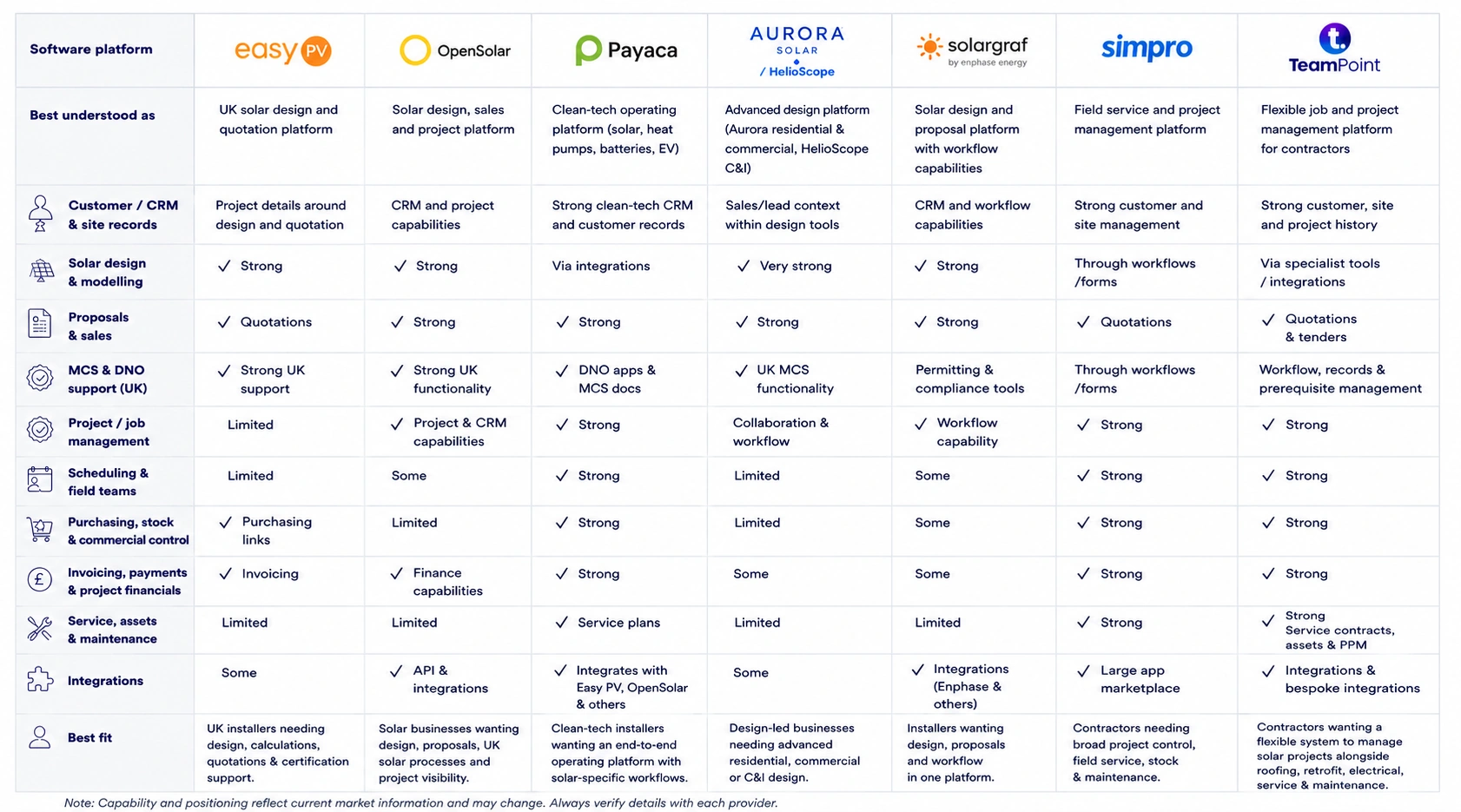
Some are highly specialist. Platforms such as Easy PV, OpenSolar, Aurora Solar, HelioScope and Solargraf are designed around solar-specific tasks such as system design, roof layout, shading, generation modelling, inverter and battery configuration, proposals and technical documentation. Some also support MCS and DNO processes, so they can play an important role well beyond the initial design stage.

Alongside those are clean-tech operating platforms such as Payaca. These are built around the wider renewable-installation journey and can combine CRM, quotations, scheduling, project tracking, field working, MCS documentation and DNO processes, while connecting to specialist design tools. For a business focused mainly on solar, heat pumps, batteries and EV charging, that can bring a large part of the workflow into one system.

Broader job and field service management platforms take a different approach. Systems such as Simpro and TeamPoint are designed to manage the wider contracting operation: customers, sites, quotations and tenders, projects, scheduling, operatives, subcontractors, purchasing, stock, compliance, invoicing, service contracts and maintenance. Solar becomes one workstream within the same operational structure used for the rest of the business.

That distinction matters if solar is only part of what you do.

A retrofit contractor may be delivering PV alongside insulation, ventilation and heat pumps. A roofing business may need roof repairs or replacement completed before the solar team can start. An electrical contractor may be managing solar installations alongside reactive and planned maintenance. In each case, the operations team needs to see the relationship between those activities rather than manage solar as a separate island.

Specialist software is essential for the solar industry

A solar designer needs software built for solar design. The person dealing with DNO or MCS requirements may need specialist functionality. An equipment-monitoring platform may remain the best place to view system performance after installation.

The operational problem appears when the useful information from those systems is difficult for the rest of the team to see.

Procurement may need the latest specification. The scheduler needs to know whether an approval has arrived. The installation team needs the correct drawings and site information. Finance needs to know when the work and supporting evidence are complete.

If that information sits across separate applications, inboxes and spreadsheets, people end up filling the gaps. Someone checks with the designer, phones the project manager or searches for the latest document. That creates more interruptions and makes the business increasingly dependent on a few experienced people knowing where everything is.

You may also like

How to Manage Multi-Site Roofing Contracts
Industry Knowledge
Written by
Rosie Cottell
Rosie Cottell

How to Manage Multi-Site Roofing Contracts

Multi-property roofing contracts are easier to manage when every property or work package is recorded as a separate job within one connected project. This gives teams detailed site-level records while allowing managers to monitor overall progress, purchasing, variations, invoicing, retentions and profitability from one place.

05.08.2026
Read More
A Practical Guide to Modernising Your Service Business
Digital Transformation
Written by
Rosie Cottell
Rosie Cottell

A Practical Guide to Modernising Your Service Business

A practical guide to modernising your field service business by improving the way people, information and technology work together. Explore how to strengthen day-to-day operations, support employees, build compliance into every job, use data more effectively and create a business that keeps improving.

03.08.2026
Read More
Is It Time to Change Your Job Management Software?
Job Management Software
Written by
Rosie Cottell
Rosie Cottell

Is It Time to Change Your Job Management Software?

Replacing your field service management software is a significant decision. If your current platform no longer reflects the way your business operates, this guide will help you understand when it's time to make a change, what to look for in a new system and how to plan a successful transition with minimal disruption.

20.07.2026
Read More
How to Grow Your Service Business Without Losing Control.
Running a Service Business
Written by
Rosie Cottell
Rosie Cottell

How to Grow Your Service Business Without Losing Control.

Growing a successful service business isn't just about winning more work. It's about making sure your business continues to run efficiently as it becomes larger and more complex. This article explores the habits shared by successful service businesses, from building dependable processes and keeping information connected to managing projects, compliance and business performance. Discover how the right operational approach helps growing businesses stay organised, improve profitability and continue growing without losing control.

16.07.2026
Read More