Is It Time to Change Your Job Management Software?

Is It Time to Change Your Job Management Software?

20.07.2026inJob Management Software
Written by
Rosie Cottell
Rosie Cottell
HOME/KNOWLEDGE CENTRE/is-it-time-to-change-your-job-management-software-
Job Management Software20.07.2026

Is It Time to Change Your Job Management Software?

Replacing your field service management software is a significant decision. If your current platform no longer reflects the way your business operates, this guide will help you understand when it's time to make a change, what to look for in a new system and how to plan a successful transition with minimal disruption.

Choosing to work with a field service management platform was a significant decision. Integrating it into your business will have taken time, commitment and investment from everyone involved. Naturally, you expected it to support your business for many years to come. But it doesn't always work like that because successful companies grow, diversify and change. So a platform that was the right choice a few years ago may no longer be working well for you today.

With so many job management platforms available, choosing between them is difficult. There just isn't one platform that's right for everyone. Every provider has its own strengths and every business has different priorities.

If you're reading this guide, there's a good chance you're already considering a change. You're certainly not alone. Many businesses that move to TeamPoint have plenty of experience of working with job management systems. They're not looking for field service management software for the first time—they're looking for software that's a better fit for the business they've become.

In this guide, we'll look at why businesses decide to switch field service management software, what to consider when comparing alternative platforms and how TeamPoint helps customers make the move successfully.

How do you know that it's Time for a Change?

Changing field service management software isn't a decision you'll make lightly. There are almost certainly aspects of your existing system that work well and that you'd be reluctant to lose. You've invested time in implementing it, your team knows how to use it and it has probably played an important part in helping your business reach where it is today. That can make it difficult to recognise when the balance begins to shift.

The first signs are often quite subtle. Everyday tasks take longer than they should, information has to be entered more than once and features that once seemed useful quietly fall out of use. People develop their own workarounds, spreadsheets start creeping back into everyday operations and processes that were intended to save time gradually become more complicated.

As your business grows, those frustrations often become harder to ignore. You introduce new services, win larger contracts and take on more demanding compliance requirements, yet the software still reflects the way your business operated several years ago. You may also find that capabilities you've come to rely on are only available as optional modules or paid upgrades. Add the cost of additional users and consultancy for changes, and what once felt like a competitively priced system can become significantly more expensive to run.

If you're tied into fixed-term contracts, the timing of a move can become another consideration. Many businesses naturally review their options as renewal dates approach, but where different modules or user licences renew at different times it's easy to keep putting the decision off. Sometimes that's the right approach. On other occasions, making a clean break and moving everything to a single platform proves simpler, less disruptive and more cost-effective than managing a phased transition over several years.

Support is another area that often prompts people to start looking for alternatives. When your job management software sits at the centre of your business, it has to work well all the time. A problem with scheduling, the mobile app or invoicing can quickly affect the office, your engineers on site and ultimately your customers. Waiting days for a support ticket to be answered, struggling to speak to somebody who understands the issue or feeling like just another number in a queue is frustrating. You need more than someone who can fix faults. You need experienced people who can answer questions, offer practical advice and help you get more from the system as your business continues to grow.

There probably won’t be one defining moment that tells you it's time to change. Your software may still be doing many things well, just as it did when it was first introduced, and everyone in the business is familiar with it. The difference is that you have outgrown it and now need capabilities that it doesn't provide. The question isn't whether your existing software is good or bad, but whether it's still the right platform for the business you've become.

Feature Image
Support

What should you Consider before Switching?

If you've reached the point where you're considering changing field service management software look beyond demonstrations, feature lists and monthly licence costs. 

The platform you choose will become the most important operational system in your business. It will influence how your office works, how engineers communicate, how quickly customers receive information and how easily managers can understand what's happening across the business. It's a decision that will shape the way you work for years to come.

One of the first things to consider is how well the software reflects the way your business actually operates. Every contractor is different. Some businesses focus on reactive call-outs, others manage planned maintenance programmes, long-term service contracts or complex projects. It's equally important to think beyond your immediate requirements. The capabilities that matter today may not be the ones you'll need in three or five years' time. As your business grows, you may introduce new services, take on larger contracts, strengthen your compliance processes or want greater visibility of performance across the business. Changing software is a significant investment, so it's worth choosing a platform that already has the capability to support your future plans, not just where you are today.

It's also worth thinking about the people who will use the platform every day. Schedulers, office administrators, engineers, project managers, accounts teams and directors all need different information to do their jobs effectively. The product should look and feel right with an intuitive interface and simple structure. It should be possible to refine workflows, permissions, dashboards and reporting so each person sees what they need without complication, while everyone continues to work from the same connected information.

Pricing deserves careful consideration too. A competitive monthly licence fee doesn't always tell the full story. Ask what's included as standard, which capabilities require additional modules, how extra users are charged and whether configuration, training, support or future changes carry additional costs. Understanding the total cost from the outset makes it much easier to compare different platforms fairly and avoid unexpected surprises later.

The software itself is only part of the decision. You're also choosing the company that will help you implement it, support it and develop it over the years ahead. Ask yourself how much importance you place on responsive support, training, ongoing guidance and working with people who take the time to understand how your business operates. A software supplier can be a long-term partner, not simply a company that provides licences and answers support tickets.

Finally, think carefully about the implementation itself. Replacing a business-critical platform is not just an IT project; it's an opportunity to improve the way your business operates. Existing data needs to be transferred, established processes often benefit from being reviewed and people need time to become confident with new ways of working. Consider the change as an opportunity to take a fresh look at how your business operates and choose a software provider that can help you improve it, not simply replace it.

Feature Image

Why do Businesses choose Teampoint?

If you've read this far, you'll probably recognise that choosing new field service management software doesn’t have to be just about replacing one system with another. It's about finding a platform that's a better fit for the business you've become and the business you're still building.

By this stage, most companies aren't comparing feature lists as much as they're comparing approaches. They want to know whether a platform will reflect the way they already work, whether it can support new opportunities as the business evolves and whether they're making a decision they'll still feel confident about several years from now. 

One of the main reasons that our customers choose TeamPoint is that we know that each business is unique. We take time to understand how work flows from the first customer enquiry through quotations, scheduling, mobile working, compliance, invoicing and reporting. We look for unnecessary administration, duplicated information and processes that have gradually become more complicated than they need to be. Only then do we plan how TeamPoint will work for the individual company.

That approach matters because no two businesses are exactly alike. Two roofing companies may carry out similar work yet organise their operations in completely different ways. One may specialise in reactive repairs, while another manages planned maintenance contracts and large commercial projects. Some businesses have multiple divisions, each with their own terminology, documentation and reporting requirements. At TeamPoint we don’t expect every organisation to work in exactly the same way. Our aim is to provide a consistent foundation while allowing each business to retain the processes that make it successful.

Just as importantly, changing software is an opportunity to look forwards as well as backwards. The aim isn't simply to replace everything your previous system already did. It's to make sure the next platform can support the capabilities your business is likely to need in the future. That might mean stronger compliance management, more sophisticated project management, customer portals, better reporting, greater automation or AI-assisted scheduling. The software that helped you reach today's turnover may not be the software that helps you reach tomorrow's.

Flexibility, however, only has value if people actually enjoy using the software. Engineers, schedulers, project managers, accounts teams and directors all need different information to do their jobs effectively. TeamPoint allows screens, permissions, dashboards and workflows to be tailored around each role keeping complex operations as simple as possible. TeamPoint fits naturally into the working day so that people spend less time thinking about the system and more time focusing on customers and the work itself.

Businesses don't just choose TeamPoint for the software. They choose it because they know they'll continue working with the people who built it. Selecting a field service management platform isn't a one-off purchase; it's the beginning of a long-term relationship. Training is delivered around the way your business operates rather than through a generic demonstration, and implementation is only the starting point. As your business develops, we're there to answer questions, review workflows, introduce new functionality and help you make better use of the platform. Those ongoing operational reviews often identify opportunities that weren't priorities during the original implementation. One long-standing customer, for example, initially chose TeamPoint to manage jobs rather than quotations. As the business evolved, a later review identified an opportunity to bring quotations into the platform, improving visibility, reducing administration and creating a more connected workflow without changing the way the business operated.


The same collaborative approach shapes the future of TeamPoint itself. Many new features don't begin with someone asking for another button or another menu. They begin with customers explaining a genuine operational challenge. Our development team works alongside them to understand the underlying problem, explore different approaches and test solutions before making them available to other customers. That means development is driven by real operational experience rather than assumptions about how service businesses should work. A current example is an AI-assisted large batch scheduling tool being developed in collaboration with a long-standing customer to help schedulers allocate hundreds of routine jobs more efficiently while retaining complete control over planning decisions.

Our customers choose TeamPoint because they want a platform that supports the way they work, has the flexibility to move forward with them and is backed by people who remain invested in their success long after implementation has finished. We believe field service management software should never become something a business has to work around. It should continue evolving alongside the people who rely on it, making the business easier to run year after year.

Feature Image
Collaborative development

How does TeamPoint make Switching Easier?

Changing field service management software is a significant decision. By the time most businesses reach that point, they have years of customer records, job history, quotations, invoices, compliance documents and operational knowledge stored in their existing system. At the same time as making a transition, the business still needs to function as usual, schedule work, support customers and keep projects moving.

It's understandable to have concerns about making the transition. Questions about transferring data, training staff, maintaining productivity and avoiding disruption are completely understandable. A successful implementation isn't simply about moving information from one system to another; it's about helping people adopt new ways of working with confidence.

That's why every TeamPoint implementation starts by understanding how your business operates. Before configuration begins, we take time to learn how enquiries are managed, how jobs are scheduled, how engineers complete work on site, how compliance is handled and how invoicing fits into the wider operation. Rather than asking you to change the way you work to fit the software, we configure TeamPoint around the way your business already operates.

Introducing a new system is a great opportunity to improve the way the business works. Drawing on our experience of working with service businesses across a wide range of industries, we can often suggest practical improvements that simplify day-to-day processes, improve communication and reduce unnecessary administration. Many customers tell us that one of the biggest benefits isn't just having new software, but having simpler, more consistent ways of working across the business.

Every business approaches implementation differently. Some are ready to move everything across in one go, while others prefer a more gradual approach, perhaps starting with quotations, planned maintenance contracts, one department or a particular group of customers before rolling TeamPoint out across the wider business. Some customers begin with a trial version of Teampoint so that they can familiarise themselves with it before using it to run real work.

Training follows the same philosophy. Rather than expecting everyone to learn the entire platform, we train each role in the areas they'll use every day. Schedulers, engineers, office teams, accounts staff and managers each receive training that's relevant to their responsibilities. Training is delivered in the way that works best for your business, whether that's online sessions, visits to your premises before and during go-live, or a combination of both. Our growing library of training videos also allows staff to revisit topics and explore additional functionality whenever they need to.

Successful implementations are rarely limited by technology. More often, they're shaped by how confidently people embrace new ways of working. That's why TeamPoint offers every customer a complimentary change management session with an experienced change management coach. The session provides practical guidance on communicating change, engaging staff and helping teams feel confident throughout the transition.

For larger organisations, implementation is often supported on site by members of the TeamPoint team working alongside office staff during go-live. Questions can be answered immediately, workflows refined as people begin using the system and, because the people providing support are also the developers who build TeamPoint, technical questions and new ideas can be discussed and resolved there and then.

Feature Image
Change management coach Kate Collins

Going live isn't the end of the implementation; it's the beginning of the next stage. As your team becomes more confident, we're there to answer questions, refine workflows and help you make better use of the platform. Regular operational reviews provide opportunities to discuss how your business is evolving, introduce new functionality and identify further improvements. Those conversations often inspire future development, with enhancements created for one customer frequently becoming part of TeamPoint for the benefit of many others.

Because TeamPoint is continually being developed, every customer also benefits from ongoing improvements as part of their standard licence. Rather than remaining on an ageing version of the software, you'll always have access to the latest functionality and upgrades, helping your business benefit from modern technology and practical innovations driven by real operational experience.

Changing field service management software will always require planning and commitment, but at TeamPoint we do our very best to minimise disruption. With a structured implementation, practical training and ongoing support, the transition becomes a positive step forward rather than an operational headache. Before long, TeamPoint simply becomes part of the working day, allowing your team to concentrate on delivering great service while your business continues to grow with confidence.

Select Your Industry Sector

Facilities Management

Facilities Management

TeamPoint helps UK facilities management and property services businesses manage reactive work, planned maintenance, compliance, service contracts, and client reporting from one connected cloud-based platform.

View Sector
Utilities

Utilities

TeamPoint helps UK utilities and infrastructure contractors take control of their operations — from planned works and reactive callouts through to compliance, reporting, and project completion.

View Sector
Commercial cleaning

Commercial cleaning

TeamPoint helps commercial cleaning businesses manage recurring work, service contracts, compliance, client reporting, and mobile teams from one connected cloud-based platform.

View Sector
Retrofit

Retrofit

TeamPoint helps retrofit businesses manage assessments, compliance, project delivery, documentation, and reporting from a single cloud-based system.

View Sector
Building Maintenance

Building Maintenance

TeamPoint helps building maintenance companies manage reactive repairs, planned maintenance, service contracts, compliance, and reporting from a single cloud-based system.

View Sector
Solar

Solar

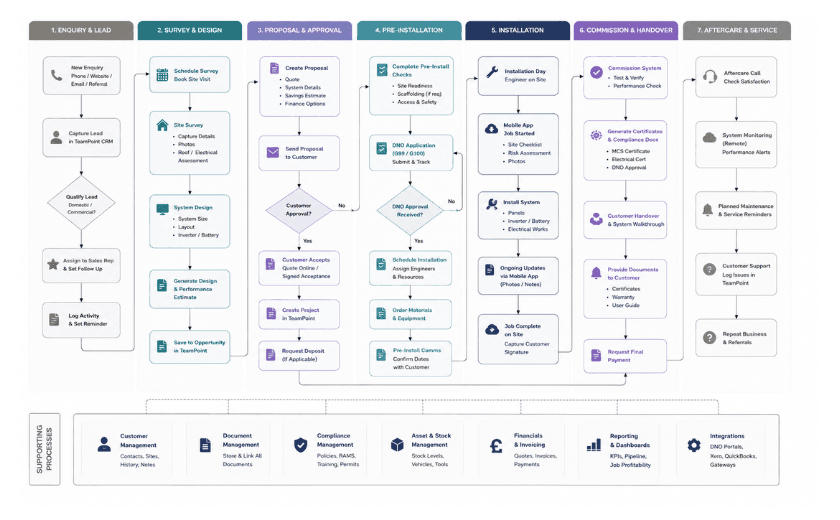
TeamPoint helps solar installation businesses manage every stage of a project — from initial enquiry and survey through to installation, compliance, and customer handover.

View Sector
Drainage

Drainage

TeamPoint helps drainage, waste management, and environmental service businesses take control of their operations — from first callout through to completion, compliance and reporting.

View Sector
Roofing

Roofing

TeamPoint helps UK roofing contractors take control of their operations — from first enquiry through to project completion and compliance.

View Sector
Support Hub

Frequently Asked Questions

If you're considering changing field service management software, you'll probably have questions about the process, the risks and what to expect. Here are answers to some of the questions businesses ask most often when planning a move to a new platform.

Help Desk

Still have questions?

Can't find the answer you're looking for? Our friendly UK-based support team is a message away and ready to help.

Talk To Us
Changing job management software requires planning, but it is rarely as disruptive as businesses expect. A well-managed implementation includes data migration, configuration, training and ongoing support, allowing your team to continue operating while the new system is introduced. Most businesses find that the long-term improvements in efficiency, communication and visibility quickly outweigh the short period of change.
In most cases, yes. Customer records, site information, job history, quotations, invoices and other important information can usually be transferred from your existing system. The exact process depends on the software you're currently using and the quality of the data, so it's worth discussing migration early in the implementation process.
Every business is different, so there is no single answer. The timescale depends on factors such as the size of your business, the amount of historical data, the complexity of your workflows and how much configuration is required. Some businesses are ready to get started within a few weeks while larger organisations may choose a phased implementation.
Not usually. Most successful implementations focus on teaching people the parts of the system they need for their role rather than every feature available. Office staff, engineers, managers and accounts teams all use the platform differently, so training is normally tailored to each group. As confidence grows, additional features can be introduced over time.
Look beyond feature lists and monthly licence costs. Consider how well the platform reflects the way your business operates, whether it can support future growth, how responsive the support team is, what ongoing costs are involved and how straightforward the implementation process will be. You're choosing a long-term operational platform, not just another software subscription.
There is rarely a single moment when the decision becomes obvious. Many businesses begin looking when they notice increasing administration, disconnected systems, duplicated data, growing compliance requirements or software that no longer reflects the way the business operates. Others review their options when licence renewals approach or when they're planning for future growth.
Every business has different priorities, but many organisations choose TeamPoint because it combines flexible field service management software with a collaborative implementation process and ongoing UK-based support. Rather than expecting businesses to adapt to the software, TeamPoint is configured around the way each organisation operates, helping teams improve efficiency while providing a platform that continues to evolve as the business grows.

You may also like

How to Grow Your Service Business Without Losing Control.
Running a Service Business
Written by
Rosie Cottell
Rosie Cottell

How to Grow Your Service Business Without Losing Control.

Growing a successful service business isn't just about winning more work. It's about making sure your business continues to run efficiently as it becomes larger and more complex. This article explores the habits shared by successful service businesses, from building dependable processes and keeping information connected to managing projects, compliance and business performance. Discover how the right operational approach helps growing businesses stay organised, improve profitability and continue growing without losing control.

16.07.2026
Read More
Has Your Service Business Outgrown the Way It Operates?
Running a Service Business
Written by
Rosie Cottell
Rosie Cottell

Has Your Service Business Outgrown the Way It Operates?

As service businesses grow, the systems and processes that once worked well can gradually become disconnected, making information harder to find, increasing administration and slowing growth. This article explores six signs your business may have outgrown the way it operates—and how connected job management software can help simplify operations and support continued growth.

14.07.2026
Read More
What is Job Management Software? The Complete Guide for UK Field Service Businesses
Job Management Software
Written by
Rosie
Rosie

What is Job Management Software? The Complete Guide for UK Field Service Businesses

What is Job Management Software in Simple Terms? Job management software is a business platform that helps organisations plan work, manage customers, schedule engineers, complete jobs, generate invoices and monitor business performance. It connects every stage of the life-cycle of a job in one place, replacing spreadsheets, dislocated messaging and standalone systems.

10.07.2026
Read More